📑Table of Contents:
- Tesla Roof Rack Weight Limits at a Glance
- How Much Weight Can a Tesla Model 3 Roof Rack Hold?
- What Is the Tesla Model Y Roof Rack Weight Limit?
- What Is the Tesla Model S Roof Rack Weight Limit?
- What Is the Cybertruck Roof Rack Weight Limit?
- Does the Roof Box Count Toward the Weight Limit?
- What About Bike Racks?
- Can You Carry a Kayak on a Tesla Roof Rack?
- Can You Put a Roof Tent on a Tesla?
- Does the Glass Roof Support the Weight?
- Tesla Roof Rack Weight Limit vs. Vehicle Payload
- How Roof Cargo Affects Tesla Range
- Does a Roof Box Reduce Tesla Range?
- How Should Weight Be Distributed?
- Do Aftermarket Tesla Roof Racks Have the Same Limit?
- Installation Matters as Much as Weight
- What Happens If You Exceed the Weight Limit?
- Best Practices for Carrying Cargo on a Tesla Roof Rack
- Final Answer: What Is the Tesla Roof Rack Weight Limit?

A Tesla roof rack can dramatically increase cargo capacity when you need to carry bikes, skis, snowboards, surfboards, luggage, or a roof box. However, installing crossbars does not mean you can place unlimited weight on the roof.
So, what is the Tesla roof rack weight limit? The answer depends on the vehicle. The Tesla Model 3 roof rack carries up to 150 pounds, while the Model Y roof rack supports up to 165 pounds. Meanwhile, Cybertruck crossbars support up to 220 pounds per two-crossbar set. Model S limits vary by roof type and rack generation, so owners need to check the specifications for their exact vehicle.
Importantly, the limit includes more than the luggage itself. Bike carriers, ski racks, cargo baskets, roof boxes, and other attachments also count toward the maximum weight.
Therefore, understanding how Tesla calculates roof load matters before you pack for a road trip.
Tesla Roof Rack Weight Limits at a Glance
The major Tesla roof rack limits currently look like this:
| Tesla Model | Roof Rack Load Limit |
|---|---|
| Model 3 | 150 lb / about 68 kg |
| Model Y | 165 lb / about 75 kg |
| Model Y L | 165 lb |
| Model S | Up to 150–165 lb depending on roof/rack configuration |
| Cybertruck | 220 lb / 100 kg per two-crossbar set |
| Model X | No conventional Tesla roof rack system comparable to Model 3/Y |
However, these figures represent maximum rack loads, not recommendations to carry that much weight in every situation.
Also, include the weight of attachments in the calculation.
How Much Weight Can a Tesla Model 3 Roof Rack Hold?
The Tesla Model 3 roof rack carries a maximum load of 150 pounds.
That figure includes everything mounted above the roof.
For example, if your roof box weighs 40 pounds, you would have about 110 pounds remaining for luggage, as long as the rack, attachment, and cargo stay within the specified limit.
Likewise, if two bike carriers weigh 15 pounds each, they use 30 pounds of the available capacity before you add the bikes.
Therefore, you should never calculate the limit using cargo weight alone.
Tesla’s Model 3 rack uses aluminum crossbars with T-slots that can accept compatible bike racks, ski carriers, cargo boxes, and other accessories.
However, compatibility matters as much as weight.
An accessory must fit the rack correctly and distribute its load safely across the bars.
What Is the Tesla Model Y Roof Rack Weight Limit?
The Tesla Model Y roof rack has a load rating of 165 pounds, or approximately 75 kilograms.
Therefore, the Model Y offers slightly more roof-carrying capacity than the Model 3.
This capacity makes the Model Y particularly practical for outdoor activities. For example, owners commonly use roof racks for bicycles, skis, snowboards, surfboards, kayaks, and cargo boxes.
However, the 165-pound figure still includes attachments.
If a large rooftop cargo box weighs 45 pounds, about 120 pounds remain for the items inside.
Likewise, a kayak carrier and kayak must stay under the total roof-rack limit when combined.
Additionally, Tesla now offers a separate roof rack for the Model Y L. That dedicated rack also carries a 165-pound rating.
Therefore, Model Y L owners should use the correct rack designed for their specific version rather than attempting to fit the standard Model Y system.
What Is the Tesla Model S Roof Rack Weight Limit?
Model S requires more attention because different roof designs and roof-rack generations have existed over the years.
Depending on the configuration, Tesla has published roof-rack ratings between 150 and 165 pounds.
Some current Model S roof-rack support information lists a 150-pound maximum for certain glass-roof systems and 165 pounds for older panoramic-roof configurations.
Meanwhile, some Model S owner documentation lists a 165-pound roof capacity for compatible glass-roof cars using an approved rack.
Therefore, Model S owners should not rely on a general number from another model year.
Instead, check the manual and rack instructions associated with your exact vehicle.
This is especially important for older Model S vehicles because not every roof type accepts the same rack.
What Is the Cybertruck Roof Rack Weight Limit?
Cybertruck offers substantially greater roof-rack capacity than Tesla’s passenger cars.
A two-crossbar set can support up to 220 pounds (100 kilograms).
Additionally, the Cybertruck can use crossbars in different positions, including over the roof and cargo-bed area in compatible configurations.
However, heavier rooftop loads affect vehicle handling.
A roof load raises the center of gravity. As a result, cornering, braking, and emergency maneuvers may feel different.
Therefore, Tesla recommends distributing loads evenly and driving more cautiously when carrying substantial weight overhead.
The same principle applies to every Tesla, even when the actual cargo remains well below the maximum rating.
Does the Roof Box Count Toward the Weight Limit?
Yes.
This is one of the most important details to understand.
The Tesla roof rack weight limit includes the weight of attachments installed on the crossbars.
For example, suppose a Model Y has a maximum roof load of 165 pounds.
You install:
- A 45-pound roof box
- 80 pounds of luggage
The combined load equals 125 pounds.
Therefore, the setup remains below the 165-pound roof-rack rating.
However, adding another 50 pounds of luggage would increase the total to 175 pounds and exceed the rating.
Consequently, always weigh or check the carrier’s specifications before calculating how much cargo you can add.
What About Bike Racks?
Bike racks usually work well with Tesla roof racks as long as you stay within both the Tesla and accessory limits.
For example, assume two bike carriers weigh 15 pounds each.
Two bicycles then weigh 35 pounds each.
The calculation becomes:
30 pounds for the carriers + 70 pounds for the bikes = 100 pounds.
Therefore, that setup would remain within both the Model 3 and Model Y rack limits, assuming the individual carriers also support the bicycles.
However, electric bikes can weigh considerably more than traditional bicycles.
A single e-bike may weigh 50 to 70 pounds or more.
Consequently, carrying multiple heavy e-bikes on the roof may become impractical even when the theoretical weight calculation remains close to the limit.
A hitch-mounted bike rack may provide a better solution for heavier bicycles on compatible Tesla models.
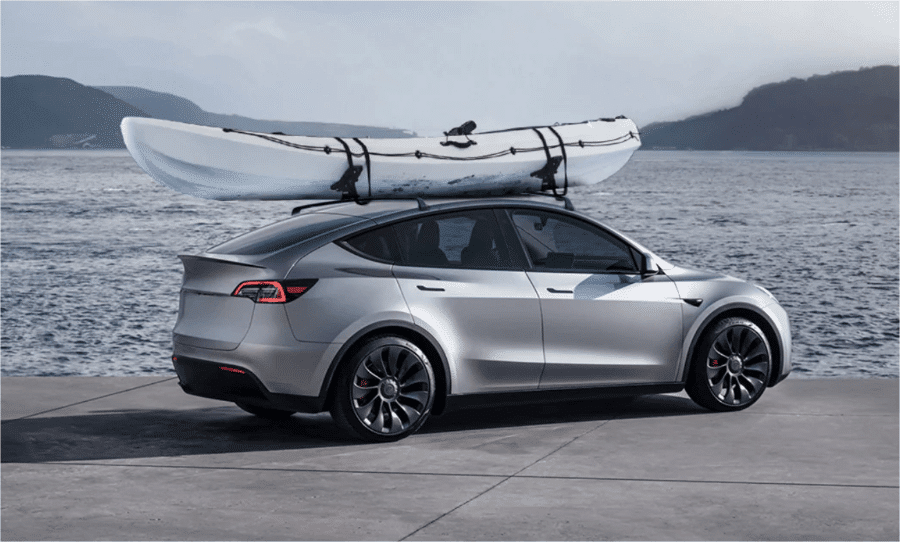
Can You Carry a Kayak on a Tesla Roof Rack?
Yes, many Tesla owners carry kayaks using compatible roof carriers.
However, you need to account for three weights:
- The kayak carrier
- The kayak
- Any additional roof-mounted equipment
Many recreational kayaks weigh roughly 40 to 70 pounds. Therefore, one kayak often fits comfortably within the Model 3 or Model Y roof-rack capacity.
However, larger fishing or tandem kayaks can become much heavier.
Additionally, kayaks create substantial aerodynamic drag because of their size.
Therefore, securing the kayak properly becomes just as important as staying below the weight limit.
High crosswinds can also exert significant force on large rooftop items even when their actual weight remains relatively low.
Can You Put a Roof Tent on a Tesla?
This question requires caution.
Roof tents create a different type of load from bikes or cargo boxes because people add significant stationary weight after parking.
Manufacturers often distinguish between dynamic load and static load.
Dynamic load refers to the weight a roof system can safely support while the vehicle moves.
Static load refers to the weight it can support while the vehicle remains parked.
However, Tesla does not publish a general static rooftop-tent capacity for every standard passenger-car roof rack.
Therefore, don’t assume that a 150- or 165-pound driving limit automatically means the roof can safely support several hundred pounds of people and camping equipment while stationary.
Additionally, Tesla vehicles use large glass roof panels, making correct attachment at the designated mounting points especially important.
Consequently, use a rooftop tent only when both the vehicle and the tent or mounting manufacturer specifically approve that combination.
Does the Glass Roof Support the Weight?
The roof rack does not simply place cargo directly onto the glass.
Tesla designed designated mounting points that transfer the load into suitable structural areas around the roof.
Therefore, correct installation becomes critical.
Incorrectly positioning the rack, tightening components improperly, or placing cargo directly on the glass can cause damage.
Also, don’t assume that because the glass roof looks strong, it can support extra cargo without the rack.
Use only the designated roof-rack mounting points and approved hardware.
This becomes particularly important when installing aftermarket roof bars.
Tesla Roof Rack Weight Limit vs. Vehicle Payload
The roof-rack limit and total vehicle payload represent two separate restrictions.
Your Tesla also has a maximum weight limit for the entire vehicle.
That calculation includes passengers and cargo.
Therefore, roof cargo still contributes to the vehicle’s overall loaded weight.
For example, imagine traveling with five passengers, a full trunk, luggage in the front trunk, and a loaded roof box.
Even if the roof box stays below the roof-rack limit, the entire vehicle could still exceed its total allowable load.
Consequently, check the Tire and Loading Information label on the vehicle when carrying unusually heavy loads.
You need to satisfy both limits, not just the roof-rack rating.
How Roof Cargo Affects Tesla Range
Roof racks and roof cargo can reduce range because they increase aerodynamic drag.
However, weight itself often creates less of an efficiency penalty at highway speeds than poor aerodynamics.
A streamlined empty crossbar system may create only a modest impact.
In contrast, a large roof box, bicycles, a kayak, or other bulky equipment can significantly disrupt airflow.
As a result, highway energy consumption can rise.
Speed makes the effect stronger.
For example, aerodynamic resistance increases dramatically as vehicle speed rises. Therefore, driving faster with a roof box can reduce efficiency much more noticeably than driving moderately.
If you plan a long Tesla road trip with rooftop cargo, leave additional charging margin between Supercharger stops.
Does a Roof Box Reduce Tesla Range?
Yes, although the exact reduction varies widely.
A streamlined cargo box usually creates less drag than several exposed bicycles.
However, the size, shape, position, speed, wind conditions, and driving route all influence efficiency.
Cold temperatures can also combine with rooftop drag to further reduce range.
So avoid relying on a single universal percentage.
Instead, monitor your Tesla’s actual energy consumption after adding the roof load.
The navigation system can then help you adjust charging stops based on real driving conditions.
How Should Weight Be Distributed?
Avoid putting all the cargo on one side of the rack.
Instead, distribute weight as evenly as possible between the two crossbars and across the vehicle’s width.
Additionally, keep heavy items low whenever possible.
For example, placing dense objects inside the trunk usually makes more sense than putting them in a rooftop box.
The roof works better for lighter, bulky equipment that consumes significant interior space.
Therefore, sleeping bags, clothing, skis, or other relatively lightweight equipment often make better rooftop cargo than heavy tools or dense equipment.
A lower center of gravity improves vehicle stability.
Do Aftermarket Tesla Roof Racks Have the Same Limit?
Not necessarily.
An aftermarket manufacturer may advertise a higher crossbar capacity than Tesla’s rack.
However, that doesn’t automatically increase what the vehicle can safely carry.
The maximum usable load depends on the weakest limit in the system.
That may include:
- The vehicle roof limit
- The crossbars
- Mounting hardware
- Cargo carrier
- Bike or kayak holder
So, if an aftermarket rack claims a 200-pound rating but your vehicle’s approved roof limit is lower, follow the lower figure.
Additionally, Tesla warns owners to use approved roof-rack systems and the correct mounting points.
Incorrect equipment can damage the roof or glass.
Installation Matters as Much as Weight
Even a light load can cause problems if you install the rack incorrectly.
Before every long trip, inspect the mounting points and attachments.
Additionally, check the rack after driving a short distance following a new installation.
Cargo straps can settle, attachments can shift, and vibrations may reveal loose components.
Therefore, recheck the system periodically during long journeys.
You should also inspect the rack after traveling on rough roads or through severe weather.
Never rely solely on the fact that the cargo felt secure when you left home.
What Happens If You Exceed the Weight Limit?
Overloading creates several risks.
First, excessive weight can damage the rack or mounting points.
Additionally, overloaded roof cargo increases the vehicle’s center of gravity and can change handling.
Hard cornering may produce more body movement, while emergency braking can generate large forces on the rack.
Moreover, cargo weight becomes dramatically more dangerous during a collision.
Therefore, the stated limit should not become a target that you intentionally exceed by a few pounds.
Leave some margin when practical, especially for long highway journeys or challenging road conditions.
Best Practices for Carrying Cargo on a Tesla Roof Rack
A few simple habits can make roof transportation safer.
First, calculate the combined weight of every attachment and item.
Next, distribute the load evenly and secure it according to the accessory manufacturer’s instructions.
Additionally, avoid heavy cargo when the same item can fit safely inside the vehicle.
Check rack hardware before long journeys and inspect straps during stops.
Also remember the vehicle may need more stopping distance and may react differently in strong crosswinds.
Finally, plan for increased energy consumption.
These steps make it easier to use the extra cargo space without unnecessarily stressing the rack or vehicle.
Final Answer: What Is the Tesla Roof Rack Weight Limit?
The Tesla roof rack weight limit depends on the model.
The Model 3 roof rack supports up to 150 pounds, while the Model Y roof rack carries up to 165 pounds. The dedicated Model Y L rack also has a 165-pound rating.
Cybertruck allows significantly more, with a maximum of 220 pounds per two-crossbar set.
Meanwhile, Model S owners should check their exact roof and rack generation because Tesla has published different limits for different configurations.
Most importantly, these limits include the weight of attachments. Therefore, a cargo box, bike rack, ski carrier, or kayak holder reduces the amount of actual cargo you can add.
Additionally, stay within the vehicle’s overall payload rating and distribute roof cargo evenly.
Ultimately, Tesla roof racks provide useful extra storage for road trips, bikes, skis, kayaks, and outdoor equipment. However, the safest setup comes from respecting the specified weight limit, using the correct mounting hardware, and remembering that anything placed on the roof can affect handling, efficiency, and range.