📑Table of Contents:
- Why Margot Robbie’s Wuthering Heights Costumes Got Attention
- Jacqueline Durran’s Costume Vision
- Cathy Earnshaw’s Wedding Dress
- Corsets, Lace, and Gothic Femininity
- Period Accuracy Versus Emotional Accuracy
- Margot Robbie’s Press Tour Looks
- The Power of Method Dressing
- How the Outfits Shape Cathy Earnshaw
- Why the Debate Helps the Film
- Final Thoughts
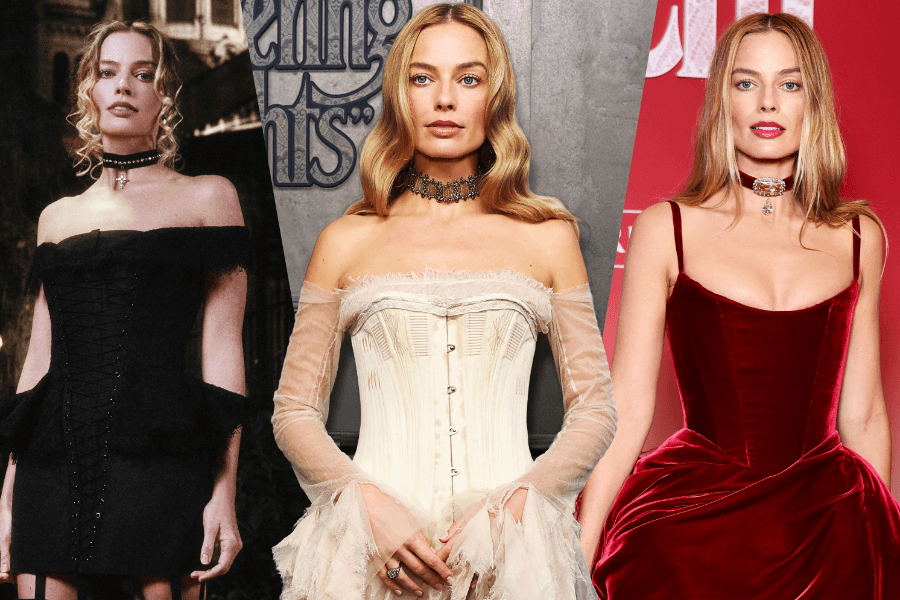
Margot Robbie outfits Wuthering Heights became a major fashion conversation before many viewers even saw Emerald Fennell’s adaptation. Set photos, first-look images, and press tour appearances turned Robbie’s Catherine Earnshaw into a style lightning rod. Some fans expected muddy hems, restrained Regency silhouettes, and bleak moorland realism. Instead, the film’s costume world leaned into fantasy, sensuality, couture references, corsetry, lace, exposed shoulders, dramatic volume, and gothic romance.
However, the debate over Robbie’s Wuthering Heights outfits goes beyond whether a single dress looks “accurate.” It raises a larger question about costume design in literary adaptations. Should clothes recreate a historical period, or should they reveal the emotional world of the film? In this version, costume designer Jacqueline Durran appears to choose atmosphere over strict realism. Therefore, Robbie’s outfits function less like museum garments and more like visual poetry for Cathy’s desire, class tension, wildness, and self-destruction.
Why Margot Robbie’s Wuthering Heights Costumes Got Attention
The first major wave of attention came when photos showed Robbie as Catherine Earnshaw in a dramatic ivory wedding-style dress. Viewers quickly debated the look online. Critics pointed out that Wuthering Heights was published in 1847 but is set in the late 1700s and early 1800s, while Robbie’s gown seemed to reference later bridal fashion and even mid-20th-century couture influences.
That criticism had a historical basis. White wedding dresses became widely fashionable after Queen Victoria’s 1840 wedding, which came decades after much of the novel’s main story. Additionally, fashion scholars noted that Cathy’s film wardrobe drew on a much wider time period than the novel’s setting. Yet the controversy also helped the film. The outfits made people look, argue, share, and ask what kind of Wuthering Heights Fennell wanted to make.
Consequently, Robbie’s costumes became a marketing force. They signaled that this adaptation would not offer a quiet, traditional Brontë world. Instead, it would push the story toward a fever dream, erotic gothic, and editorial fashion.
Jacqueline Durran’s Costume Vision
Jacqueline Durran, the Oscar-winning costume designer behind films such as Little Women, Anna Karenina, and Barbie, designed the costumes for Wuthering Heights. Vogue’s first-look interview with Durran reported that Cathy alone had between 45 and 50 costumes, including overlaps and reuse. That number matters because it suggests a highly detailed visual arc rather than a few signature dresses.
Durran described building a bold, expressive world for the film rather than simply reproducing one decade of fashion. Fashion scholars later described the costumes as drawing on roughly 500 years of fashion references. As a result, Robbie’s Cathy can move through styles that feel historical, theatrical, erotic, romantic, and modern simultaneously.
This approach fits Emerald Fennell’s filmmaking style. Fennell often combines beauty, excess, and discomfort. In Promising Young Woman and Saltburn, style never functions as decoration alone; it exposes power, desire, performance, and rot. Therefore, Robbie’s Wuthering Heights wardrobe likely works as character psychology as much as it does as period clothing.
Cathy Earnshaw’s Wedding Dress
The wedding dress became the most discussed outfit because it looked deliberately anachronistic. Fashion commentary connected it to a 1951 Charles James haute couture influence rather than a historically strict late-18th-century or early-19th-century gown. The result creates a huge, sculptural silhouette that feels more like a trapped fantasy than a practical wedding garment.
That choice makes sense for Cathy. Her marriage to Edgar Linton represents social elevation, repression, and separation from Heathcliff. Therefore, an exaggerated wedding dress can show the weight of that choice. Instead of making Cathy look simply innocent or romantic, the gown can make her look enclosed, displayed, and consumed by status.
Additionally, the dress’s ivory tone and exposed shape intensify the contradiction. It looks bridal, sensual, fragile, and theatrical at once. Critics may call it inaccurate, but the garment clearly communicates emotional conflict. In a gothic romance, that may matter more than perfect chronology.
Corsets, Lace, and Gothic Femininity
Robbie’s Wuthering Heights costumes lean heavily into gothic femininity. Corsets, lace, pale fabrics, dark accents, bare shoulders, and dramatic skirts create a visual language of constraint and desire. These elements suit Cathy because she lives between wild nature and social control. She wants freedom, but she also wants power, comfort, and recognition.
Corsetry matters symbolically. A corset shapes the body, but it also suggests discipline and restriction. On Cathy, corseted styling can imply the pressure to become a socially acceptable woman while her emotions remain chaotic. Lace adds delicacy, but it can also look ghostly or decayed under the right lighting. Meanwhile, pale fabrics contrast with the mud, wind, and brutality of the moors.
Moreover, the costumes appear designed for emotional contrast. Cathy can look like a bride, a ghost, a fantasy, or a prisoner depending on the scene context. That flexibility enhances Robbie’s performance, as the clothes become part of the character’s instability.
Period Accuracy Versus Emotional Accuracy
The biggest debate around Margot Robbie’s Wuthering Heights outfits centers on accuracy. Historical costume experts and fans quickly noticed timeline issues. However, other critics argued that period dress does not always need perfect fidelity, especially when a director creates a heightened interpretation.
This distinction matters. Period accuracy asks whether a dress matches the year, place, class, textile technology, and social custom. Emotional accuracy asks whether a dress expresses the character and the film’s world. Fennell’s Wuthering Heights seems to prioritize the second question.
Of course, this approach can frustrate readers who love Brontë’s original setting. The novel’s roughness, class tensions, and rural isolation all connect to its historical world. However, costume fantasy can reveal another truth: Cathy and Heathcliff’s relationship feels excessive, destructive, and almost outside time. Therefore, an anachronistic wardrobe may support the film’s feverish tone.
Margot Robbie’s Press Tour Looks
Robbie’s Wuthering Heights fashion did not stop with the film costumes. Her press tour leaned into method dressing, the same strategy that made her Barbie tour famous. Instead of wearing random luxury gowns, she and stylist Andrew Mukamal built looks that echoed gothic romance, Victorian details, corsetry, lace, dark florals, mourning jewelry, and moorland drama.
People reported that Robbie’s promotional wardrobe included designers such as Schiaparelli, Chanel Couture, Dilara Findikoglu, Roberto Cavalli, and Thom Browne, and often featured corsets, chokers, lace, trains, and gothic details. Business Insider also highlighted a dramatic custom Schiaparelli gown with a lace bodice and red-and-black train, a red leather look by Dilara Findikoglu, Chanel velvet and tulle, Thom Browne corsetry, and other Victorian-inspired pieces.
As a result, the press tour extended the movie’s visual world beyond the screen. Robbie did not merely promote Wuthering Heights; she dressed as if the story had escaped into modern fashion.
The Power of Method Dressing
Method dressing works when an actor’s public outfits echo the movie’s themes. Robbie used this brilliantly during Barbie, and Wuthering Heights gave her another strong visual universe. However, the mood changed completely. Barbie relied on bright colors, play, nostalgia, and doll-like perfection. Wuthering Heights demanded darkness, romance, obsession, and texture.
Therefore, Robbie’s press tour looks helped audiences understand the film before release. Corsets suggested constraint. Lace suggested fragility. Red accents suggested passion and violence. Black velvet suggested gothic drama. Mourning-inspired accessories connected to Brontë’s atmosphere of death and haunting.
Additionally, method dressing gives entertainment media something concrete to discuss. Even people who have not read Wuthering Heights can understand a gothic gown, a corset, or a stormy romantic silhouette. Consequently, fashion becomes part of the film’s storytelling campaign.
How the Outfits Shape Cathy Earnshaw
Cathy Earnshaw is not an easy character. She can seem passionate, selfish, trapped, brilliant, cruel, romantic, and self-dividing. Her clothes need to carry those contradictions. Robbie’s outfits appear to emphasize Cathy as both object of desire and agent of chaos.
The grand dresses show status and fantasy. The corseted shapes show restriction. The delicate fabrics show vulnerability. The dramatic silhouettes show appetite. Meanwhile, the gothic styling points toward death, haunting, and emotional extremity. Therefore, the wardrobe helps Cathy feel mythic rather than simply realistic.
This matters because modern audiences often meet literary characters first through images. A still photo of Robbie in costume can define expectations before a trailer or review. In that sense, the outfits helped create a new Cathy: less dusty classic heroine, more dangerous fashion apparition.
Why the Debate Helps the Film
The costume controversy may sound negative, but it keeps the movie in public conversation. Fans discuss history. Fashion writers analyze silhouettes. Brontë readers debate fidelity. Robbie fans share red-carpet images. As a result, the outfits become a cultural entry point.
Additionally, the debate reflects larger changes in period drama. Many recent adaptations use historical settings with modern emotional language, diverse casting, contemporary music, or stylized costumes. Some viewers love that freedom. Others want stricter realism. Wuthering Heights sits directly inside that tension.
Ultimately, Robbie’s outfits force the audience to decide what they want from an adaptation. Do they want the past reconstructed, or do they want the novel reimagined as a visual and emotional storm?

Final Thoughts
Margot Robbie’s outfits in Wuthering Heights became famous because they refuse to disappear quietly into the background. From Cathy’s controversial wedding dress to the gothic press-tour wardrobe, the fashion in the film turns Brontë’s world into something sensual, theatrical, and fiercely debated. The costumes may not satisfy every historian, but they clearly create a bold visual identity.
Ultimately, Robbie’s Wuthering Heights style works because it captures the story’s emotional weather. The outfits suggest love, confinement, status, decay, obsession, and haunting beauty. Whether viewers call them inaccurate, magnificent, or both, they accomplish one crucial task: they make Catherine Earnshaw impossible to ignore.