📑Table of Contents:
- Why The Press Tour Became A Fashion Story
- The Andrew Mukamal Effect
- The Gothic Romance Palette
- The Blood-Red Premiere Moment
- The Hairdresser and Victorian Mourning References
- The Alexander McQueen Skull-Print Finale
- How Jacob Elordi Fit Into The Press Narrative
- Why The Tour Invited Debate
- Why The Press Tour Worked
- The Bigger Picture
Last updated on June 2nd, 2026 at 02:59 am
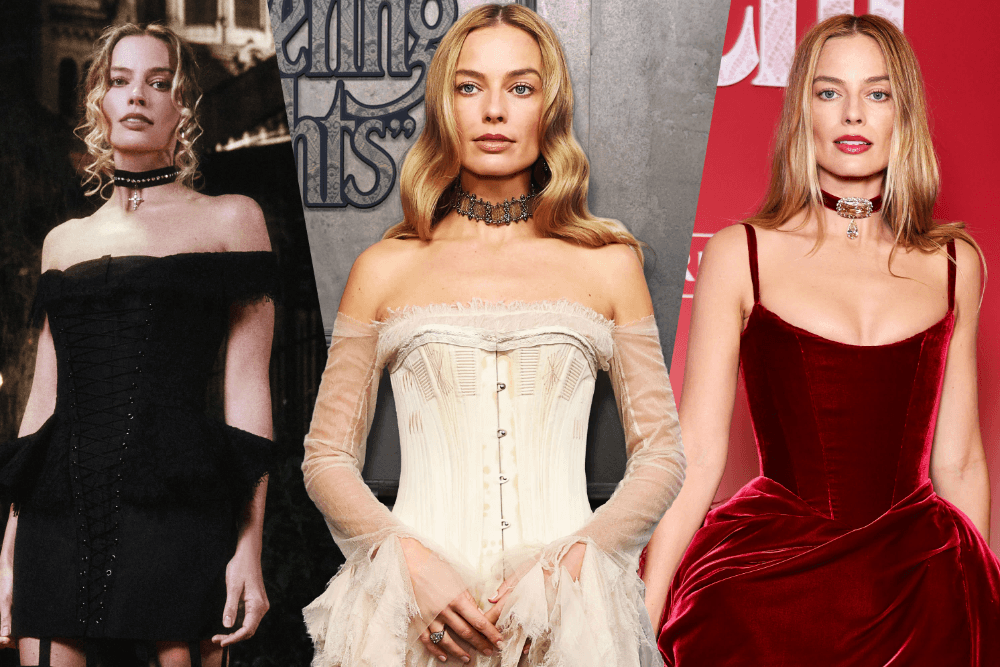
Margot Robbie’s Wuthering Heights press tour became a fashion event before the film even reached theaters. After the cultural takeover of her Barbie tour wardrobe, audiences expected another carefully built style narrative. However, Robbie and stylist Andrew Mukamal did not simply repeat the pink, doll-inspired formula. Instead, they shifted into something darker, moodier, and more literary: gothic romance through couture.
The press tour supported Emerald Fennell’s film adaptation of Emily Brontë’s Wuthering Heights, starring Robbie as Catherine Earnshaw and Jacob Elordi as Heathcliff. Warner Bros.’ official film site presents the movie as Fennell’s take on the classic story, with Robbie and Elordi leading the cast. The film arrived with major anticipation because it brought together Robbie, Elordi, Fennell, LuckyChap, and one of English literature’s most famously obsessive love stories.
Moreover, the movie’s release strategy leaned into romance and provocation. Reports ahead of release noted that Wuthering Heights was set for February 13, 2026, directly ahead of Valentine’s Day weekend. That date gave the campaign a sharp contrast: a holiday associated with love, paired with a story about passion, cruelty, class, haunting, and emotional ruin.
Why The Press Tour Became A Fashion Story
Margot Robbie does not approach major press tours casually. Her Barbie wardrobe turned promotional dressing into a global conversation because every look referenced a specific doll, decade, or visual code. Therefore, when she re-teamed with Andrew Mukamal for Wuthering Heights, fashion watchers immediately expected another “tourdrobe” with meaning.
This time, the source material demanded a different language. Wuthering Heights does not call for cheerful color-blocking or plastic-fantastic glamour. It calls for storm clouds, corsetry, obsession, blood-red romance, windblown wildness, and the emotional violence of Cathy and Heathcliff. Consequently, Robbie’s wardrobe moved into Victorian details, sheer fabrics, dark romance, antique references, feathers, lace, corsets, and jewelry with symbolic weight.
W Magazine described the tour as a fusion of period-inspired silhouettes and modern couture, noting that Robbie and Mukamal channeled the film’s brooding intensity without making the looks feel like costumes. That distinction matters. The best press tour fashion does not literally dress an actor as the character. Instead, it extends the film’s atmosphere into the public world.
The Andrew Mukamal Effect
Andrew Mukamal’s role deserves attention because he has helped turn Robbie into one of the most strategic red carpet storytellers in Hollywood. With Barbie, he built a clear visual archive: every look connected to Mattel history, nostalgia, and character marketing. With Wuthering Heights, he had a harder job. Brontë’s novel does not offer a neat set of collectible outfits. Instead, it offers mood, violence, longing, landscape, and literary symbolism.
Mukamal responded by treating the tour like a gothic visual essay. Rather than simply putting Robbie in black gowns, he pulled from historical references, romantic silhouettes, and designers who understand drama. Coverage of the tour highlighted designers such as Schiaparelli, Chanel, Thom Browne, Roberto Cavalli, Dilara Findikoglu, Alexander McQueen, Maison Margiela, and others.
Additionally, Mukamal’s styling avoided the obvious trap of making every outfit look like a period costume. Robbie did not arrive dressed as a museum piece, Cathy. She arrived as a modern star translating Cathy’s world through fashion: structured, haunted, sensual, and sometimes dangerous.
The Gothic Romance Palette
The dominant mood of the tour was gothic romance. That phrase can sound vague, but Robbie’s looks gave it shape. She wore deep tones, sheer textures, sharp tailoring, Victorian-inspired accents, and dramatic accessories. Moreover, her clothes often suggested conflict: softness against restraint, romance against menace, beauty against decay.
Who What Wear argued that the tour wardrobe carried symbolic meaning beyond surface glamour, connecting recurring motifs such as feathers, snakeskin, Victorian lace, and signet rings to the film’s themes of obsession, rebellion, and dangerous devotion. This interpretation fits the story. Cathy Earnshaw is not a polite romantic heroine. She is wild, conflicted, proud, and destructive. Therefore, the wardrobe needed to feel beautiful but not safe.
That approach made the tour more interesting than a standard awards-season fashion run. Each look seemed to ask, “What would Cathy’s emotional weather look like as couture?” The answer often arrived in stormy fabrics, exposed skin, old-world jewelry, and silhouettes that looked both controlled and ready to come undone.
The Blood-Red Premiere Moment
One of the most discussed press tour ideas involved red as a symbol of passion, violence, and doomed love. According to fashion coverage, Robbie’s world-premiere look leaned into blood-red drama, with Who What Wear describing a custom Schiaparelli gown and a historically rich Cartier Taj Mahal necklace as part of the tour’s symbolic storytelling.
That kind of look works because Wuthering Heights is not a gentle romance. It is a story of emotional extremity. Cathy and Heathcliff’s bond turns love into injury, obsession, and haunting. Red, therefore, becomes more than a Valentine’s color. It becomes the color of possession, sacrifice, and wounds that never close.
Furthermore, the choice of necklace added another layer. Jewelry can serve as a prop in press-tour storytelling, especially when it carries historical or romantic associations. Robbie’s accessories throughout the tour often did more than complete outfits. They deepened the mood.
The Hairdresser and Victorian Mourning References
Perhaps the most startling look of the tour came in London, where Robbie wore a near-sheer dress with real-hair details by Dilara Findikoglu. People reported that the gown referenced the Victorian era’s fascination with hair and included a corseted shape, braided green hair elements, floral hair details, and a replica of Charlotte Brontë’s hair bracelet.
This look captured the tour’s intelligence. Hair jewelry may sound strange to modern audiences, but in the Victorian period, people often used hair in mourning objects and sentimental keepsakes. Therefore, the dress is connected directly to the world around Brontë: memory, death, longing, and the physical preservation of love.
Additionally, the gown understood Wuthering Heights as much as a ghost story as a romance. Cathy’s presence haunts Heathcliff long after life and love fail them. A dress built around hair, memory, and bodily relics turns that haunting into fashion. It also shows why Robbie’s tour attracted so much attention: the looks carried research, not just shock value.
The Alexander McQueen Skull-Print Finale
Robbie also closed part of the tour with a striking Alexander McQueen skull-print look. Marie Claire reported that she attended Vogue Australia’s Summer Ball in Sydney wearing a sheer custom Alexander McQueen slip dress that revived the house’s iconic skull motif, originally associated with McQueen’s early-2000s fashion language.
This look made sense for Wuthering Heights because McQueen’s archive has long blended beauty, death, romance, and British gothic sensibility. The skull print did not simply say “dark.” It connected the film’s doomed love story to a fashion house famous for turning mortality into glamour.
Moreover, Robbie’s use of McQueen felt like a bridge between literary Gothic and fashion Gothic. Brontë’s moors, ghosts, class tensions, and violent longing belong to the novel’s world. McQueen’s skulls, chiffon, and historic references belong to runway mythology. Together, they gave Robbie a tour look that felt both cinematic and culturally layered.
How Jacob Elordi Fit Into The Press Narrative
Although Robbie’s fashion led much of the discussion, Jacob Elordi’s presence shaped the tour’s romantic charge. The two stars appeared together at promotional stops, in interviews, and in magazine coverage. Vogue Australia placed Robbie and Elordi on its February 2026 cover, with the cover story describing their chemistry and the film’s release campaign.
Their pairing mattered because Cathy and Heathcliff require intensity. A Wuthering Heights press tour cannot only sell costumes; it must sell dangerous chemistry. Therefore, the campaign leaned into closeness, tension, and shared visual storytelling. Even when Robbie’s wardrobe took center stage, Elordi’s styling and presence completed the atmosphere.
Additionally, media coverage of their interviews emphasized how both actors understood the characters’ love as something that begins early, mutates, and becomes impossible to resolve. CinemaBlend reported that Robbie saw Cathy and Heathcliff’s bond beginning in childhood fear and intimacy, while Elordi described Heathcliff’s first sight of Cathy as overwhelming and cosmic. That emotional framing supported the fashion story: this was not just a stylish tour, but a campaign built around obsession.
Why The Tour Invited Debate
The Wuthering Heights press tour not only earned praise. It also raised eyebrows. The Independent described the early promo as intense and “delulu,” noting that Fennell’s film was already one of the year’s most hyped releases and that its marketing invited strong reactions.
That debate makes sense. Wuthering Heights has a long history of adaptations, and readers often feel protective of Brontë’s novel. Some want a faithful, restrained period drama. Others welcome a sensual, modern, provocative version. Fennell’s style, especially after Promising Young Woman and Saltburn, suggested that the film would not play it safe.
Consequently, Robbie’s fashion also became part of the debate. Was the tour too sexy, too stylized, too fashion-forward, or too literal? Or did it capture the novel’s feverish emotional logic better than polite heritage dressing could? That tension helped keep the campaign alive online.
Why The Press Tour Worked
Robbie’s press tour worked because it translated the film’s themes without reducing them. Instead of wearing generic “period drama” gowns, she wore clothes that evoked captivity, wildness, mourning, desire, and decay. Furthermore, each major look gave fans something to decode.
The tour also benefited from timing. After Barbie, Robbie had already trained audiences to read her press wardrobes as storytelling. Therefore, viewers arrived prepared to analyze every dress, shoe, necklace, and historical reference. Mukamal and Robbie used that expectation, but they did not simply copy the old formula. They changed genre completely.
Additionally, the campaign understood that modern movie promotion depends on images that travel. A trailer reaches movie fans. A viral dress reaches fashion fans, TikTok users, literary readers, and people who may not follow film news at all. As a result, the press tour expanded the movie’s cultural footprint.

The Bigger Picture
Margot Robbie’s Wuthering Heights press tour became a case study in how fashion can sell a film’s emotional world. Working again with Andrew Mukamal, Robbie traded Barbie pink for gothic intensity, Victorian references, sheer fabrics, antique jewelry, McQueen skulls, and designs that cast Cathy Earnshaw as both a romantic heroine and a destructive force.
Ultimately, the tour mattered because it did more than promote a movie. It transformed a literary adaptation into a visual event. Each look carried mood, reference, and debate. Moreover, the wardrobe helped position Fennell’s Wuthering Heights as something bold rather than dusty: a story of love as obsession, beauty as danger, and romance as a storm.
So, when people search for “Margot Robbie press tour Wuthering Heights,” they are not only looking for outfits. They are looking at how a modern star uses fashion to interpret a 19th-century novel before audiences even enter the theater. In that sense, Robbie’s tour did exactly what great press fashion should do: it made the movie feel visible, emotional, and impossible to ignore.