📑Table of Contents:
- What Makes A Wedding Band Unusual?
- 1. Curved And Contoured Wedding Bands
- 2. Nature-Inspired Wedding Bands
- 3. Colored Gemstone Wedding Bands
- 4. Mixed-Metal Wedding Bands
- 5. Hammered And Textured Bands
- 6. Geometric And Architectural Wedding Bands
- 7. Open And Negative-Space Bands
- 8. Celestial Wedding Bands
- 9. Asymmetrical Diamond Bands
- 10. Engraved And Secret-Detail Bands
- Choosing The Right Metal
- How To Match An Unusual Band With An Engagement Ring
- Final Thoughts
A wedding band may be one of the smallest pieces of jewelry you own, yet it often carries the greatest meaning. While classic polished gold and diamond eternity rings remain popular, many brides now want something less predictable. Unusual wedding bands for women offer exactly that opportunity.
A unique wedding band can feature an unexpected shape, colored gemstones, textured metal, asymmetric details, mixed metals, or a completely unconventional silhouette. Moreover, it can complement an engagement ring without looking like a matching set.
However, choosing something unusual does not mean sacrificing comfort or durability. The best distinctive wedding bands combine personality with practical design so you can enjoy wearing them every day.
Here are some of the most interesting wedding band styles to consider, along with tips for finding one that suits both your ring and your lifestyle.
What Makes A Wedding Band Unusual?
An unusual wedding band moves away from the traditional plain circular band or symmetrical diamond row.
Instead, designers may experiment with shape, texture, gemstones, metal colors, engraving, negative space, or architectural elements. Consequently, two rings made from the same gold can look completely different depending on their construction.
Some unique bands make a bold statement on their own. Meanwhile, others appear relatively simple until you look closely and notice an irregular edge, a hidden gemstone, a hand-carved texture, or an unexpected engraving.
Therefore, unusual does not necessarily mean extravagant. Sometimes one distinctive detail makes a ring feel genuinely personal.
1. Curved And Contoured Wedding Bands
Curved bands have become especially useful for women whose engagement rings prevent a straight wedding ring from sitting flush against them.
These rings curve around the center stone or setting. However, designers can turn that practical shape into something much more creative.
For example, a band may form a gentle V, a dramatic chevron, a wave, or an asymmetric curve. Additionally, small diamonds or colored stones can follow the contour.
A curved band can also create the appearance of a custom-designed bridal set even when you purchase the engagement ring and wedding band separately.
Therefore, this style works particularly well with solitaire, halo, pear-shaped, marquise, and oval engagement rings.
2. Nature-Inspired Wedding Bands
Nature offers almost endless possibilities for unusual jewelry.
Instead of a perfectly smooth surface, a wedding band might feature leaves, vines, branches, flowers, waves, or bark-like textures. Some designs incorporate tiny gemstones as berries or blossoms, while others depend entirely on sculpted metal.
Moreover, organic patterns rarely need perfect symmetry. That slight irregularity can make the band look handmade rather than mass-produced.
Leaf and vine designs work particularly well for romantic or bohemian styles. Meanwhile, rougher branch-like textures create a more earthy appearance.
For someone who wants symbolism, nature-inspired bands can also represent growth, renewal, and a relationship that continues to develop.
3. Colored Gemstone Wedding Bands
Diamonds do not need to dominate every wedding ring.
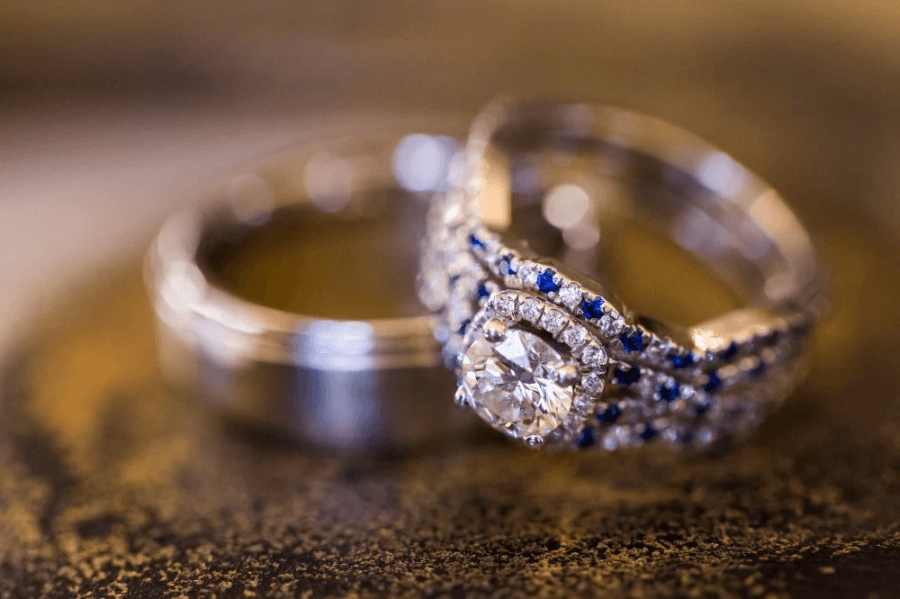
Sapphires, rubies, emeralds, spinel, and other colored stones can immediately make a band more distinctive. Additionally, alternating colored gems with diamonds can add personality without making the design excessively bold.
Blue and teal sapphires have become particularly versatile because sapphires come in many shades beyond traditional royal blue.
However, durability matters when choosing a gemstone for everyday wear. Wedding rings regularly encounter desks, door handles, bags, household tasks, and other hard surfaces.
Therefore, harder gemstones such as sapphires and rubies generally suit everyday rings better than softer or more delicate stones.
4. Mixed-Metal Wedding Bands
There is no rule requiring your wedding band to be made of the same metal as your engagement ring.
In fact, combining metals can create an intentionally layered look.
For example, a yellow-gold engagement ring can pair beautifully with a platinum or white-gold wedding band. Likewise, rose gold can introduce warmth beside white metal.
Some unusual wedding bands incorporate multiple metals into a single ring. A designer might weave white and yellow gold together or place a contrasting metal edge around the band.
Consequently, mixed-metal rings give you more flexibility when adding future anniversary or stacking rings.
5. Hammered And Textured Bands
Texture can transform an otherwise simple wedding band.
Instead of a mirror-polished finish, consider hammered, brushed, sandblasted, carved, matte, or irregular surfaces. These finishes create depth while keeping the overall design relatively understated.
Moreover, textured bands often suit women who prefer distinctive jewelry without large gemstones.
A hammered yellow-gold band, for example, can look organic and handcrafted. Meanwhile, a satin-finished platinum ring creates a more modern and architectural effect.
Keep in mind that finishes change gradually with daily wear. However, a jeweler can often refresh or recreate many textures during maintenance.
6. Geometric And Architectural Wedding Bands
For a more contemporary look, geometric bands provide an alternative to soft traditional curves.
Hexagons, sharp angles, stepped edges, repeated lines, and asymmetric stone settings can make a wedding band feel almost architectural.
Additionally, Art Deco-inspired geometry can combine vintage character with modern styling.
A geometric band works particularly well alongside a simple solitaire engagement ring because the contrast adds visual interest. However, it can also stand alone as a statement wedding ring.
Therefore, this style suits anyone who prefers clean lines over floral or romantic detailing.
7. Open And Negative-Space Bands
An open wedding band does not create one completely continuous visual circle across the top of the finger. Instead, the design leaves a deliberate gap between two ends.
Designers may finish those ends with diamonds, gemstones, leaves, stars, geometric shapes, or sculptural metal details.
Consequently, the empty space becomes part of the design.
Open bands can also sit nicely around certain engagement ring settings. However, construction matters because thin or heavily open designs may bend more easily than substantial traditional bands.
Therefore, choose a well-made ring with enough structure for regular wear.
8. Celestial Wedding Bands
Stars, moons, constellations, and sun motifs can create an unusual wedding ring without making it overly elaborate.
Small diamonds can represent stars, while engraved celestial patterns add detail directly into the metal.
Moreover, celestial designs can carry personal symbolism. A couple might choose a constellation connected with a meaningful date or select stars to represent family members.
These rings often work beautifully in yellow gold, although white gold and platinum can create a cooler night-sky aesthetic.
9. Asymmetrical Diamond Bands
Traditional diamond bands usually repeat the same stone shape and size around the ring. An asymmetrical design deliberately breaks that pattern.
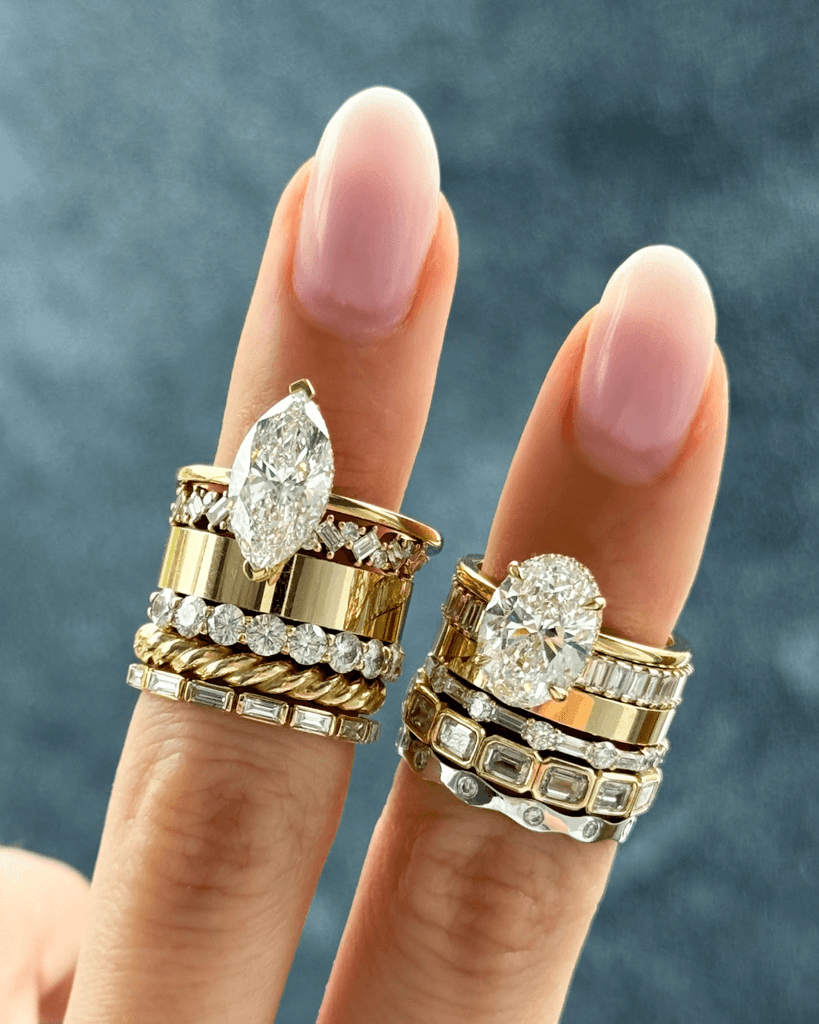
For example, one section may contain a marquise diamond beside a round stone, followed by smaller baguettes or an unexpected gap.
The result feels spontaneous rather than perfectly uniform.
Additionally, combining different diamond cuts introduces texture without requiring colored gemstones. Pear, baguette, marquise, round, and princess-cut stones each reflect light differently.
Consequently, an asymmetrical diamond band can still feel luxurious while looking noticeably different from a classic eternity ring.
10. Engraved And Secret-Detail Bands
Sometimes the most unusual feature does not need to be visible to everyone.
A simple band can hide a date, phrase, fingerprint pattern, coordinates, symbol, initials, or tiny gemstone on the inside.
Moreover, engraving allows couples to create something deeply personal without dramatically changing the outward appearance.
Hand engraving can also decorate the outside with scrollwork, botanical motifs, geometric patterns, or custom illustrations.
Therefore, engraving offers an excellent option for someone who wants individuality without a highly unconventional ring shape.
Choosing The Right Metal
The metal affects both appearance and long-term practicality.
| Metal | Why Consider It |
|---|---|
| 14K Gold | Durable, practical, and available in yellow, white, or rose |
| 18K Gold | Richer gold color with a luxurious feel |
| Platinum | Dense, naturally white, and highly suitable for daily wear |
| Titanium | Lightweight and modern |
| Tungsten | Very scratch-resistant with a distinctive contemporary look |
However, alternative metals such as tungsten and titanium may offer fewer resizing options than traditional precious metals. Therefore, confirm resizing possibilities before buying.
How To Match An Unusual Band With An Engagement Ring
Start by examining the profile of your engagement ring.
If its setting sits low, a straight wedding band may leave a gap. Therefore, a curved or contoured ring may create a better fit.
Next, consider visual balance. A highly detailed engagement ring often works beautifully with a simpler textured band. Conversely, a minimalist solitaire leaves room for a more decorative wedding ring.
Additionally, do not assume that both rings need identical metals, stones, or design periods. A deliberate contrast can create a more personal combination.
Most importantly, try the rings together whenever possible. Photographs cannot always show how two bands interact when they actually sit on the finger.
Final Thoughts
Unusual wedding bands for women offer far more possibilities than the traditional polished ring or diamond eternity band.
You can explore curved silhouettes, colorful gemstones, botanical textures, mixed metals, celestial motifs, geometric shapes, asymmetrical diamonds, or hidden personal details. Moreover, you can combine several ideas to create something completely individual.
However, appearance should not be the only consideration. Think about comfort, durability, gemstone hardness, resizing, and how the band interacts with your engagement ring.
Ultimately, the best unusual wedding band is not simply the most dramatic design. Instead, it is the ring that feels unmistakably yours and remains comfortable enough to become part of everyday life.