📑Table of Contents:
- Does Age Make a Comic Book Valuable?
- Why Are First Appearances So Valuable?
- What Is a Key Issue?
- How Much Does Condition Affect Comic Book Value?
- Does Page Quality Matter?
- Does Rarity Automatically Make a Comic Valuable?
- Why Does Character Popularity Matter?
- Do First Printings Matter?
- Can Variant Covers Be Valuable?
- Do Signatures Increase Comic Book Value?
- What Is Comic Book Provenance?
- Does Restoration Reduce Comic Book Value?
- Does Professional Grading Increase Value?
- How Can You Find Out What a Comic Is Worth?
- What Makes Comic Books Valuable? The Simple Answer
What makes comic books valuable? The answer usually comes down to rarity, condition, historical importance, character significance, collector demand, and provenance. A comic does not become valuable simply because it is old. Likewise, a newer comic can sometimes command a high price if collectors strongly want it and few desirable copies exist.
First appearances often generate the greatest attention. However, important origin stories, first issues, iconic covers, character debuts, low print runs, unusual variants, and historic creative work can also increase demand.
Therefore, determining comic book value requires looking at the entire issue, not just its publication date.
Does Age Make a Comic Book Valuable?
Age can help, but it does not create value on its own.
Older comics often command higher prices because fewer copies survive. During the early decades of comic publishing, readers generally bought comics as inexpensive entertainment rather than collectibles. Consequently, children folded them, traded them, wrote on them, discarded them, or simply wore them out through repeated reading.
Moreover, paper drives, poor storage, moisture, and ordinary deterioration destroyed many early copies.
Therefore, a high-grade comic from the 1940s can be extraordinarily difficult to find.
However, many old comics have relatively modest values because collectors don’t demand them much. So, rarity only becomes financially important when people actually want the book.
Why Are First Appearances So Valuable?
First appearances rank among the most important factors in comic collecting.
Collectors often want the issue that introduced a famous character into comic-book history. For example, Action Comics #1 features Superman’s first appearance, while Amazing Fantasy #15 introduced Spider-Man.
Similarly, The Incredible Hulk #181 remains highly desirable because collectors associate it with Wolverine’s first full appearance.
These comics represent historical starting points. Therefore, fans often consider them essential pieces of a character’s history.
However, collectors sometimes debate whether a brief cameo counts as the true first appearance. As a result, understanding the collecting community’s accepted terminology can significantly affect value.
What Is a Key Issue?
A key issue includes an event that makes the comic more important than surrounding issues.
First appearances provide the most obvious examples. However, key issues can also feature:
- A character’s origin
- The first appearance of a major villain
- A significant character death
- A new costume or identity
- The first issue of an important series
- A historic creative-team debut
- A major wedding or storyline
- A famous cover
- An important crossover
- The first appearance of a team
Therefore, two consecutive comics from the same year can have dramatically different values.
One may contain an ordinary story, while the next introduces a character who later becomes internationally famous.
How Much Does Condition Affect Comic Book Value?
Condition can make an enormous difference.
Collectors typically evaluate defects such as spine stress, creases, tears, missing pieces, stains, fading, writing, detached covers, rusty staples, and damaged pages.
Consequently, two copies of exactly the same comic can sell for very different amounts.
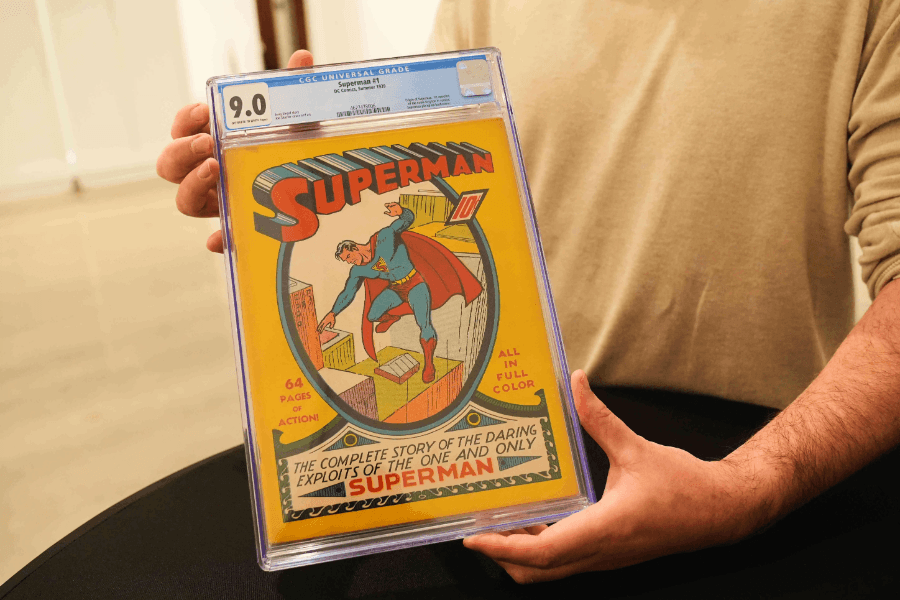
Professional grading companies use numerical scales that help buyers compare condition more consistently. At the upper end, grades such as 9.8 represent exceptionally well-preserved comics. Meanwhile, heavily worn books receive much lower grades.
However, older comics do not always need extremely high grades to remain valuable.
A rare Golden Age key may command substantial demand even in poor condition because so few complete examples survive.
Does Page Quality Matter?
Yes. Collectors pay attention to the condition of the interior paper as well as the cover.
Fresh white pages generally attract stronger interest than heavily aged brown or brittle pages. Moreover, page quality provides clues about how well the comic survived storage over several decades.
Paper naturally changes over time. Heat, humidity, light, and acidic storage conditions can accelerate deterioration.
Therefore, two comics with similar exterior grades may still appeal differently if one has bright pages while the other shows significant aging.
Brittleness presents a particularly serious concern because fragile pages can break during handling.
Does Rarity Automatically Make a Comic Valuable?
No. Rarity and value are related, but they aren’t the same.
Imagine a comic with only 100 surviving copies. That sounds exceptionally rare. However, if only 20 people want it, scarcity alone won’t drive up the price much.
Now imagine another comic with thousands of surviving copies but tens of thousands of collectors seeking one. Consequently, strong demand may push its value much higher.
This relationship can be summarized simply:
Value usually increases when strong demand meets limited desirable supply.
Therefore, collectors should consider both scarcity and popularity.
Why Does Character Popularity Matter?
Popular characters create larger collecting audiences.
Spider-Man, Batman, Superman, Wolverine, the X-Men, and other major characters have attracted generations of fans. Consequently, important comics connected to them often enjoy deeper demand than equally rare issues featuring forgotten characters.
Movies, television series, games, and animation can also bring new attention to a character.
For example, an upcoming film adaptation may encourage collectors to search for that character’s first appearance. However, entertainment-driven price increases can also reverse if enthusiasm fades.
Therefore, media attention can influence comic values, but speculation always carries risk.
Do First Printings Matter?
Usually, yes.
When publishers reprint successful comics, collectors generally prefer the original first printing. Therefore, identifying the printing correctly can make a substantial difference.
However, the distinction is not always obvious.
Publishers may change small details such as the cover price, copyright information, advertisements, logo placement, or printing notation. As a result, inexperienced sellers sometimes mistake later printings for valuable originals.
Before Estimating Value, Identify:
- Series title
- Issue number
- Publication year
- Publisher
- Printing
- Cover version
That information provides a much stronger starting point than searching only for the character pictured on the cover.
Can Variant Covers Be Valuable?
Yes, especially when the variant had significantly lower distribution.
Modern publishers often release several covers for the same issue. Some appear in roughly equal quantities, while others use retailer incentives such as one variant for every 25, 50, or 100 standard copies ordered.
As a result, certain variants become difficult to obtain.
However, rarity alone still does not guarantee long-term value. Collectors must continue wanting the cover, artist, issue, or character.
Popular cover artists can also create additional demand. Therefore, a visually striking variant by a sought-after artist may outperform less popular alternatives.
Do Signatures Increase Comic Book Value?
Sometimes.
A signature from an important writer, artist, or creator can make a comic more desirable. Moreover, authenticated or witnessed signatures usually give buyers greater confidence.
For example, collectors may value a key issue signed by the character’s creator more highly than an unsigned equivalent.
However, not every autograph adds value.
An unwanted signature can reduce a comic’s appeal for collectors who prefer untouched copies. Therefore, the signer’s identity, authentication, placement, rarity, and the comic itself all matter.
What Is Comic Book Provenance?
Provenance means the documented ownership or history of a collectible.
Most ordinary comics gain little from knowing who previously owned them. However, exceptional vintage collections can matter in the hobby.
Recognized pedigree collections contain unusually well-preserved vintage comics with documented histories. As a result, collectors may pay premiums for books from famous collections.
Similarly, a comic with documented ownership by a notable creator or historical figure may attract additional interest.
Therefore, provenance can turn an already desirable comic into an even more distinctive collectible.
Does Restoration Reduce Comic Book Value?
Restoration can significantly affect market value.
Examples include adding color to damaged areas, filling missing pieces, replacing sections, reinforcing tears, or altering the comic to improve its appearance.
Although restoration may make a book look better, many collectors prefer untouched original copies.
As a result, restored comics often sell for less than comparable unrestored examples.
Conservation differs slightly because its primary goal is to stabilize and preserve the comic rather than cosmetically recreate missing material.
Therefore, buyers should always understand whether professional work has altered a valuable comic.
Does Professional Grading Increase Value?
Professional grading can make valuable comics easier to buy and sell because an independent company evaluates condition and encapsulates the book in a protective holder.
Moreover, certification can identify restoration, page quality, signatures, and other relevant characteristics.
However, grading does not automatically make every comic valuable.
A common modern comic worth only a few dollars may cost more to grade than its resulting market value. Therefore, professional grading makes the most sense when condition strongly affects price or when authentication provides meaningful benefits.
How Can You Find Out What a Comic Is Worth?
Start by identifying the exact issue and estimating its condition.
Next, research actual completed sales rather than relying only on asking prices. Sellers can list a comic for any amount they want, but completed transactions reveal what buyers have actually paid.
When comparing sales, match the:
- Exact issue
- Printing
- Variant
- Grade
- Page quality
- Restoration status
- Signature status
Moreover, recent sales generally provide a better picture than prices from several years ago because collector demand changes.

What Makes Comic Books Valuable? The Simple Answer
Comic book value comes from a combination of importance, scarcity, condition, and demand.
First appearances and major key issues often command the strongest interest. Meanwhile, high grades, good page quality, low surviving populations, desirable variants, important creators, signatures, and exceptional provenance can push values higher.
However, age or rarity alone does not guarantee a valuable comic.
Ultimately, collectors pay the strongest prices for books that are difficult to obtain and culturally important enough that many people still want them. Therefore, if you discover an old comic collection, identify each promising issue carefully before assuming it is worthless—or a fortune.
The difference between an ordinary back issue and a major collectible can sometimes come down to one character’s first appearance, one unusual cover, or one exceptionally preserved copy.