📑Table of Contents:
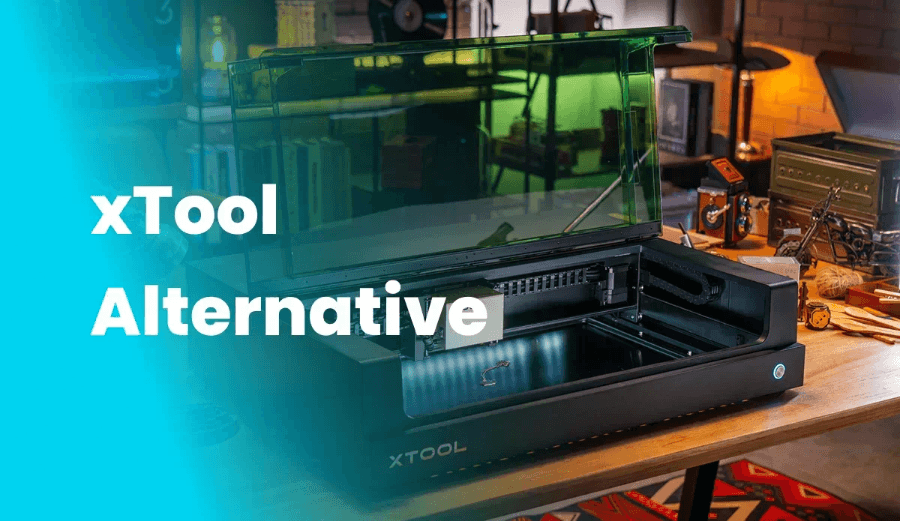
xTool has become one of the most recognizable names in desktop laser cutting and engraving. Its expanding lineup now covers diode, CO₂, infrared, fiber, MOPA, and UV laser systems. However, xTool is far from the only option available to makers, small businesses, schools, and professional workshops.
Several xTool competitors offer compelling alternatives. Some focus on lower prices, while others target professional production, simpler software, larger working areas, or specialized engraving applications.
Therefore, the right alternative depends less on the brand name and more on what you actually want to make. A machine designed for cutting acrylic signs, for example, serves a very different purpose from a fiber laser built for engraving jewelry.
Here are the leading xTool competitors to consider in 2026.
What Are the Main xTool Competitors?
The strongest competitors to xTool include Glowforge, OMTech, Thunder Laser, Gweike, Monport, Creality Falcon, and Epilog Laser.
Each company approaches the laser market differently. Glowforge emphasizes simplicity, while OMTech and Monport compete heavily on price. Meanwhile, Thunder Laser and Epilog target buyers who need more professional production capabilities.
| Brand | Strongest Area | Typical User |
|---|---|---|
| Glowforge | Ease of use | Beginners, crafters |
| OMTech | Affordable CO₂ lasers | Small businesses |
| Thunder Laser | Professional CO₂ production | Growing workshops |
| Gweike | Feature-to-price value | Makers and businesses |
| Monport | Budget CO₂ and fiber systems | Cost-conscious buyers |
| Creality Falcon | Affordable diode lasers | Hobbyists and beginners |
| Epilog Laser | Commercial-grade systems | Professional businesses |
However, comparing brands alone can be misleading. Laser source, power, work area, software, safety features, ventilation, accessories, and support all affect the ownership experience.
1. Glowforge
Glowforge remains one of xTool’s closest competitors, particularly in the desktop craft and CO₂ laser market.
The company’s biggest advantage is simplicity. Glowforge machines combine camera-assisted positioning with user-friendly software, helping new users move from a design to a finished project quickly. Consequently, Glowforge appeals strongly to teachers, Etsy sellers, home-based businesses, and crafters who do not want a complicated setup.
Its current range includes compact craft machines and more powerful Performance Series models. For example, the Glowforge Pro HD uses a 45W CO₂ laser and includes a passthrough system for longer materials.
However, Glowforge’s streamlined ecosystem can also become a limitation for advanced users. Buyers who want greater control over software, hardware, or production workflows may prefer another platform.
Glowforge makes the most sense for users who prioritize convenience over extensive customization.
2. OMTech
OMTech has built a strong following among users who want substantial CO₂ laser capability without paying premium commercial-machine prices.
The company offers everything from desktop units to larger workshop machines. Therefore, it attracts both first-time business owners and experienced users who want more cutting capacity.
The OMTech Polar Lite, for example, uses a 55W CO₂ laser in a desktop format. It also targets the same general small-business market as machines such as the xTool P2S.
Another major advantage is software flexibility. OMTech machines commonly support LightBurn, which gives experienced users considerable control over layers, speeds, power settings, and production workflows.
On the other hand, buyers should consider the entire setup rather than simply comparing laser wattage. Ventilation, cooling, accessories, workspace requirements, and technical knowledge can make a major difference.
Still, OMTech remains one of the most important xTool competitors for buyers who place a high value on CO₂ performance.
3. Thunder Laser
Thunder Laser moves further toward the professional end of the market.
Rather than concentrating primarily on casual crafting, the company develops machines for studios, schools, fabrication businesses, and production environments. As a result, Thunder Laser becomes especially interesting when a laser runs regularly rather than occasionally.
Its Bolt range uses RF CO₂ technology. The lineup includes machines designed for detailed engraving as well as larger commercial workloads. Depending on the model, Thunder’s Bolt machines offer substantially larger work areas and higher production capabilities than many hobby-oriented desktop lasers.
Furthermore, Thunder emphasizes build quality, speed, service, and long-term commercial use.
The trade-off is cost. A professional Thunder Laser setup can require a much larger investment than an entry-level xTool or Creality machine.
Therefore, Thunder Laser is worth considering when production volume, reliability, and commercial workflow matter more than minimizing the initial purchase price.
4. Gweike
Gweike competes directly with xTool across several parts of the laser market.
For desktop CO₂ cutting, the Gweike Cloud Pro II offers 50W and 55W configurations, camera positioning, LightBurn support, and a working area of roughly 510 × 300 mm. Consequently, it provides an alternative to popular enclosed desktop CO₂ machines.
Gweike also offers RF CO₂, diode, fiber, UV, and multi-laser systems. Therefore, businesses that work with several material types can find options beyond standard wood and acrylic cutting.
Price represents another attraction. Gweike often positions its machines aggressively against competing systems with similar specifications.
However, buyers should look beyond the specification sheet. Local support, replacement parts, documentation, warranty service, and shipping arrangements can matter just as much over several years of ownership.
For technically confident users, though, Gweike deserves serious consideration.
5. Monport
Monport is another important competitor for price-focused buyers.
The company sells CO₂ and fiber laser systems across a wide range of power levels. In particular, its desktop CO₂ machines compete with xTool for small workshops and home businesses.
For example, the Reno 45 series combines a 45W CO₂ laser with built-in cooling, air assist, and LightBurn compatibility. Consequently, buyers can access a relatively capable enclosed CO₂ platform without immediately moving into higher commercial price ranges.
Monport also has a broad lineup of fiber lasers. Therefore, it can appeal to businesses engraving metal tags, jewelry, tools, tumblers, machine components, and promotional products.
However, businesses should evaluate support and workflow requirements carefully before purchasing solely on price.
Monport makes the strongest case when budget matters, but the buyer still wants access to CO₂ or fiber technology.
6. Creality Falcon
Creality is widely known for 3D printers, but its Falcon range has made the company a serious competitor in desktop laser engraving.
The Falcon A1 Pro demonstrates the brand’s direction particularly well. It combines a 20W blue diode laser with an optional 2W infrared module, an enclosed Class 1 design, camera positioning, autofocus, and speeds up to 600 mm/s.
Moreover, Creality supports its own Falcon Design Space software, as well as options such as LightBurn.
As a result, Falcon models make sense for users entering laser engraving who want modern features without immediately buying a CO₂ system.
However, diode lasers and CO₂ lasers have different material capabilities. Clear acrylic, thicker acrylic cutting, and high-volume production can quickly expose the limitations of a lower-powered diode machine.
Therefore, the Creality Falcon works particularly well as an alternative to xTool for hobbyists, personalization businesses, and beginners.
7. Epilog Laser
Epilog occupies a different part of the market from most entry-level xTool competitors.
The company focuses heavily on professional and commercial laser systems. Its current ecosystem includes Fusion-series and galvo machines built for engraving, cutting, marking, and regular production work.
Epilog also provides extensive documentation, drivers, service resources, and technical support. Consequently, businesses that depend on a laser every day may view the higher purchase cost differently than hobby users do.
However, an Epilog system can cost considerably more than many desktop alternatives.
Therefore, Epilog should not necessarily be viewed as a direct replacement for an inexpensive xTool machine. Instead, it becomes relevant when a business starts prioritizing commercial reliability, workflow integration, support, and long-term production.
How To Choose Between xTool And Its Competitors
Start with the material rather than the brand.
If you primarily cut wood and acrylic, compare enclosed CO₂ machines from xTool, OMTech, Gweike, Glowforge, Thunder Laser, and Monport. Conversely, if you primarily engrave metal, look closely at fiber or MOPA machines.
Next, consider production volume. A hobbyist making several projects each month has very different requirements from a business processing hundreds of orders.
Additionally, compare the complete cost of ownership. The laser itself may require ventilation, an air purifier, a rotary attachment, a riser, a chiller, replacement filters, software, or additional accessories.
Finally, evaluate software and support. An inexpensive machine becomes far less attractive if downtime prevents you from completing customer orders.

Are There Good Alternatives To xTool?
Yes. The laser market now offers strong xTool competitors at almost every price and performance level.
Glowforge emphasizes simplicity, while OMTech and Monport compete strongly on value. Meanwhile, Creality Falcon provides accessible diode options, and Gweike covers an unusually broad range of laser technologies. Thunder Laser and Epilog, by contrast, move further toward professional production.
Ultimately, there is no single xTool alternative that fits every user. Instead, compare laser type, materials, work area, software, safety, support, and total ownership cost. Doing so will help you find a machine that fits both your current projects and your future production plans.