📑Table of Contents:
- What Happens in the Plane Stunt?
- Why Tom Cruise Keeps Using Real Stunts
- The South Africa Filming Challenge
- The Near-Miss That Made Headlines
- Physical Strain and Performance
- How the Camera Helps Sell the Danger
- Why the Biplane Matters More Than Another Jet
- The Stunt in the Context of Final Reckoning
- How It Compares to Cruise’s Other Stunts
- Final Thoughts
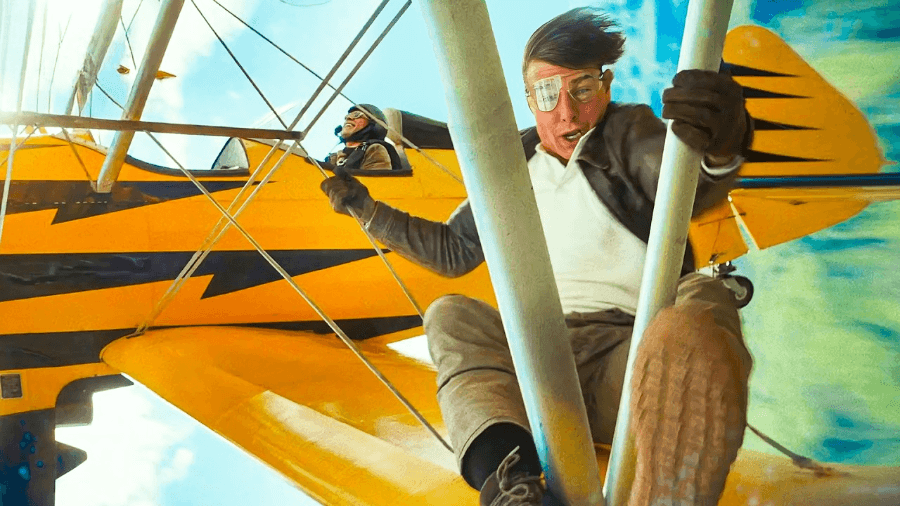
The Tom Cruise plane stunt Final Reckoning sequence became one of the biggest talking points around Mission: Impossible — The Final Reckoning because it pushed the franchise’s practical-action identity to another extreme. By this point, audiences expected Cruise to run across rooftops, hang from aircraft, jump motorcycles off cliffs, and hold his breath underwater. However, the biplane sequence still felt shocking because it placed him outside a real aircraft, high above the ground, while the plane pitched, rolled, and fought the air.
In an era when many blockbusters lean heavily on digital action, the Final Reckoning plane stunt reminded viewers why Mission: Impossible has built such a unique reputation. The sequence did not exist only to look dangerous. It existed to make danger visible. When Cruise clings to a biplane or moves between aircraft, the audience can feel wind, speed, height, and physical strain. Therefore, the scene works because it combines spectacle with the knowledge that a real performer completed much of the action for the camera.
What Happens in the Plane Stunt?
The Final Reckoning biplane sequence places Ethan Hunt in another impossible aerial situation. Without giving the entire story away, the scene involves vintage-style aircraft, midair movement, wing-walking tension, and the kind of physical problem-solving that defines the franchise. Ethan does not simply sit in a cockpit while the danger happens around him. Instead, he becomes part of the machinery, the wind, and the risk.
The stunt’s appeal comes from its simplicity. A person outside a flying plane creates instant suspense. Audiences do not need complicated exposition to understand the danger. If Ethan loses grip, timing, balance, or oxygen, the situation becomes catastrophic. Additionally, the biplane design makes the action feel more exposed than a modern aircraft interior. There is less visual separation between Cruise and the sky.
That clarity makes the scene easy to market and easy to remember. Even people who have not followed every Mission: Impossible plot point can understand the image: Tom Cruise is on a plane again, and this time the plane is smaller, older, and more unstable.
Why Tom Cruise Keeps Using Real Stunts
Tom Cruise’s Mission: Impossible career has become a long argument for practical spectacle. He has climbed the Burj Khalifa, held onto the outside of an Airbus A400M, performed a HALO jump, piloted helicopters, and launched a motorcycle off a cliff. Each stunt raises the same question: why not fake it?
The answer is audience trust. When viewers believe the actor is really there, the scene carries a different energy. Practical stunt work gives the camera permission to stay wider, hold longer, and show the body in space. Instead of cutting around danger, the film can let audiences study it.
Moreover, Cruise has built his late-career star image around effort. He does not only play Ethan Hunt as a man who refuses to quit. He promotes himself as an actor who also refuses to quit. Consequently, the plane stunt becomes both a story moment and a brand statement.
The South Africa Filming Challenge
The biplane scene was filmed over South Africa, which gave the sequence a huge sense of scale. Aerial stunt work depends heavily on weather, visibility, aircraft coordination, fuel limits, camera placement, and safety planning. Even a short usable shot can require extensive preparation.
Unlike a controlled soundstage, the sky does not reset easily. Wind changes—light shifts. Planes need fuel. Pilots must maintain safe distances while still creating cinematic proximity. Additionally, Cruise had to perform physically while dealing with speed, noise, cold air, and limited comfort.
This environment made the stunt more complicated than a simple “actor hangs from plane” headline suggests. It required pilots, stunt coordinators, camera teams, safety crews, and director Christopher McQuarrie to coordinate around real aviation limits. Therefore, the final sequence reflects engineering as much as acting courage.
The Near-Miss That Made Headlines
The stunt became even more famous after McQuarrie described a frightening moment during filming. Reports from Cannes said Cruise became stuck on top of the biplane during a wing-walking sequence. The team could not immediately tell whether he was conscious, and the aircraft was approaching fuel limits. Because landing with Cruise stuck in that position would have created danger, the moment carried real urgency.
Cruise eventually recovered and got back to the cockpit area. Still, the story revealed how thin the margin can become during practical aerial work. A stunt may look controlled in the final edit, but filming it can involve fatigue, oxygen issues, time pressure, and unpredictable movement.
That near-miss also shaped how audiences viewed the final film. The scene was not just “cool.” It became part of a larger conversation about risk, endurance, and the cost of making action feel real.
Physical Strain and Performance
The plane stunt demanded more than bravery. Cruise had to perform while his body fought wind resistance, vibration, gravity, and exhaustion. Aerial stunt work can make even basic movement difficult. Lifting an arm, turning the body, or crawling along a surface becomes harder when air pressure hits the performer at speed.
Additionally, Cruise needed to stay in character. Ethan Hunt must look desperate, focused, and reactive, not like an actor merely completing a stunt checklist. That makes the performance doubly difficult. He must survive the stunt mechanics while still telling the story emotionally.
This is where Cruise’s approach differs from a pure daredevil act. The stunt does not exist outside the movie. It supports Ethan’s panic, determination, and problem-solving. As a result, the audience experiences both real physical danger and character-driven suspense.
How the Camera Helps Sell the Danger
A stunt this ambitious only works if the camera explains the risk clearly. Wide shots help prove location and height. Closer shots show strain on Cruise’s face and body. Aerial angles show the relationship between aircraft, sky, and movement. Together, those choices help viewers understand that the sequence uses real space.
Modern audiences can be skeptical because visual effects can create almost anything. Therefore, Mission: Impossible often highlights behind-the-scenes footage as part of its marketing. Showing Cruise training, hanging from aircraft, or rehearsing dangerous movement gives the audience context before they see the finished scene.
In Final Reckoning, that strategy helped the biplane sequence become a selling point. The marketing did not ask viewers only to care about plot. It asked them to witness a filmmaking achievement.
Why the Biplane Matters More Than Another Jet
The franchise had already used aircraft in spectacular ways, especially when Cruise hung from an Airbus during Rogue Nation. Therefore, Final Reckoning needed a new angle. The biplane offered one. Its open, old-fashioned structure made the danger feel more tactile and less protected.
A large modern cargo plane suggests scale. A biplane suggests exposure. Viewers can see the wings, struts, cockpit, and open air. That design creates a more intimate kind of danger because Ethan looks physically close to every surface and every drop.
Additionally, the biplane fits the franchise’s interest in mechanical action. Mission: Impossible often creates tension from keys, masks, trains, motorcycles, submarines, and aircraft. The biplane sequence continues that tradition by turning a machine into a puzzle Ethan must survive.
The Stunt in the Context of Final Reckoning
The Final Reckoning arrived as the eighth Mission: Impossible film and was widely framed as a possible emotional capstone for Cruise’s Ethan Hunt era. Because of that, the plane stunt carried extra symbolic weight. It was not just another action beat. It felt like a final statement about what this franchise values: commitment, physical risk, theatrical scale, and big-screen experience.
The movie itself continues the conflict involving the Entity, the artificial intelligence threat introduced in Dead Reckoning. Yet many viewers came away talking about the aerial action because it gave the film a physical counterweight to its digital villain. That contrast matters. A story about AI and invisible control ends up depending on one of cinema’s oldest thrills: a human body in real danger.
How It Compares to Cruise’s Other Stunts
The Final Reckoning plane stunt belongs beside Cruise’s most famous Mission: Impossible feats. The Burj Khalifa climb emphasized height. The Rogue Nation plane takeoff emphasized speed and exposure. The Fallout HALO jump emphasized precision and altitude. The Dead Reckoning motorcycle jump emphasized commitment and timing—meanwhile, the Final Reckoning biplane stunt combined exposure, aviation, endurance, and old-school wing-walking danger.
What makes this stunt stand out is the sense of instability. A building does not move. A motorcycle follows a planned ramp. A biplane, however, reacts constantly to air, fuel, pilot decisions, and weather. Therefore, the scene feels less like a single stunt and more like a moving system of risks.

Final Thoughts
The Tom Cruise plane stunt Final Reckoning sequence became a defining moment because it captured everything audiences associate with Mission Impossible at its most extreme. It used real aircraft, real altitude, practical performance, and visible physical strain to create a scene that felt both cinematic and frighteningly immediate.
Ultimately, the biplane stunt works because it is not only about danger. It is about trust. The audience trusts that Cruise is really there. The filmmakers trust practical spectacle to compete with digital blockbusters. And the story trusts Ethan Hunt to keep choosing the impossible path. Whether The Final Reckoning marks the end of the franchise or simply another chapter, its plane stunt stands as one of Cruise’s clearest reminders that, for him, action cinema still belongs in the sky, on the wing, and in front of the camera.